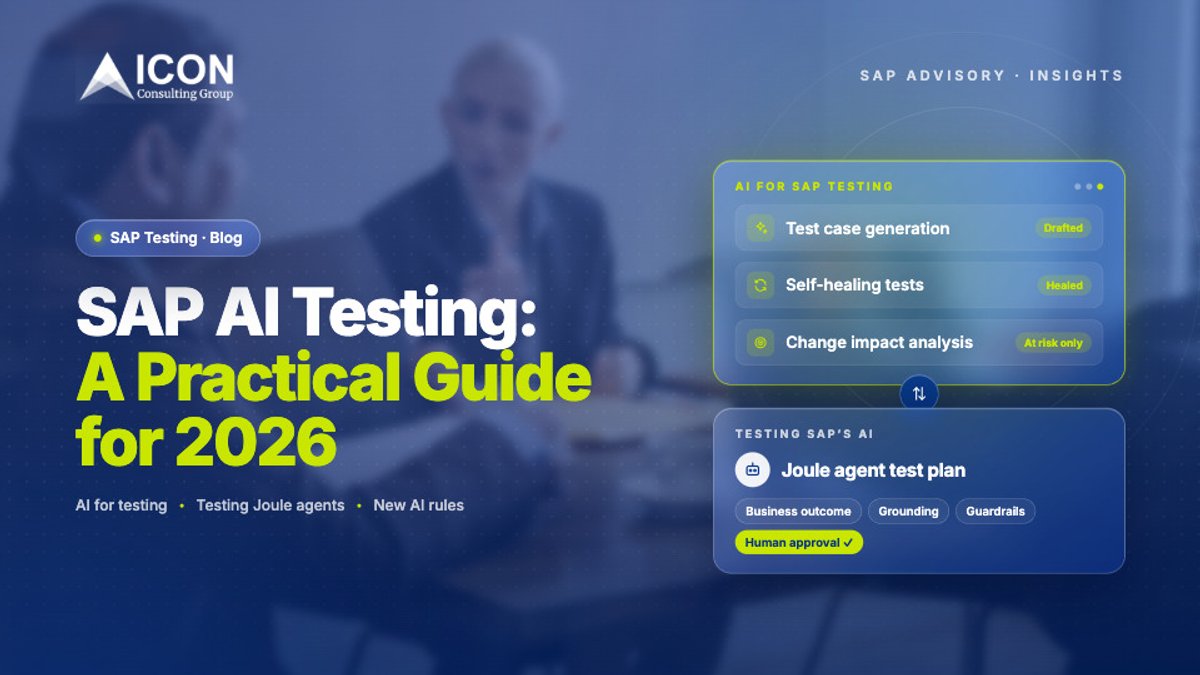
SAP AI testing means two things at once: using AI to test your SAP landscape faster.
SAP AI testing means two things at once: using AI to test your SAP landscape faster, and testing the AI features SAP now ships, such as Joule agents. Most content covers only the first. This guide covers both, shows how new rules in Singapore, Australia and the EU shape the work, and explains how Icon applies it in practice.
What is SAP AI testing?
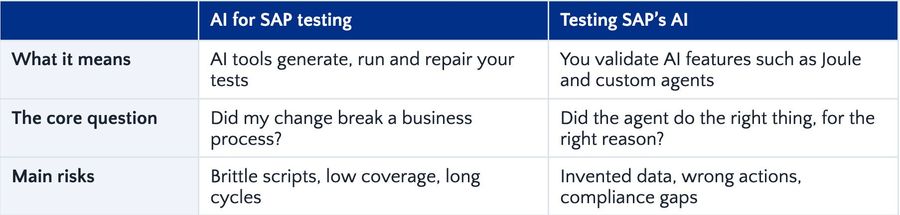
SAP AI testing is the use of artificial intelligence to plan, create, run and maintain tests across SAP systems, plus the discipline of validating SAP’s own AI features before they touch production data. Think of it as two directions of the same arrow.
The first direction is familiar. The second is newer and, in our view, the one most teams are least prepared for: when a Joule agent can create a sales order, it deserves the same scrutiny as custom code.
If you’re a QA lead wondering how day-to-day work changes, our piece on AI-augmented SAP testing for QA teams covers that side in detail.
Read more: What AI Is Changing on SAP Programmes?
How does AI improve SAP testing today?
On the AI-for-testing side, SAP AI testing helps in three places: creating test cases, keeping scripts working after changes, and deciding what to test in the first place.
With quarterly S/4HANA Cloud releases and ECC maintenance ending in 2027, manual regression testing can’t keep up.
AI test case generation
Generative AI can draft test cases from process documents or user stories. Tricentis, for example, now lets SAP Enterprise Continuous Testing customers use SAP AI Units to generate automated test cases, including end-to-end tests described in plain language. Treat the output as a strong first draft that a process expert still reviews.
Self-healing tests
Self-healing scripts notice when a Fiori or SAP GUI element changes, such as a renamed field or a moved button, and update the test automatically. That removes the maintenance work that usually stalls automation after a few releases.
Change impact analysis and risk-based testing
Change impact analysis reads your transport requests and release changes, works out which business processes they touch, and points you to the tests that matter. Tools such as SAP Change Impact Analysis by Tricentis do this down to code level.
Where AI still falls short
Here’s the nuance vendors tend to skip. A self-healed test that passes isn’t proof the business outcome is right. If the tool “heals” onto the wrong field, you get a green result for a broken process. This is known as false healing, and it’s why we recommend tracking false-healing rates and defect leakage across real releases, not just maintenance hours saved.
The second gap is data. AI-generated tests are only as good as the master data and test data behind them.
How do you test SAP Joule agents?
You test a Joule agent by checking not just its final answer, but the actions it takes, the data it relies on and the points where a person must approve.
Say an agent reads a customer email and creates a sales order. In production, it picks a customer with a similar name, or invents a material number that doesn’t exist. That’s a hallucination, and it’s the main risk to test for once agents write data into SAP.
A practical test plan for each agent should cover:
- Business outcome: correct document and values across a fixed set of known scenarios (a golden dataset).
- Tool use and permissions: only the APIs and transactions it should, under the right role.
- Grounding: every value traces back to real SAP data.
- Guardrails and human approval: human-in-the-loop checks trigger when confidence is low or values exceed limits.
- Regression after change: scenarios still pass after an SAP release or model update.
We go deeper into each of these in our guide to testing SAP Joule agents before go-live.
How does regulation shape SAP AI testing?
Regulation is turning SAP AI testing from good practice into something you need to prove. All three markets reward teams that keep a clear audit trail of what was tested and why.
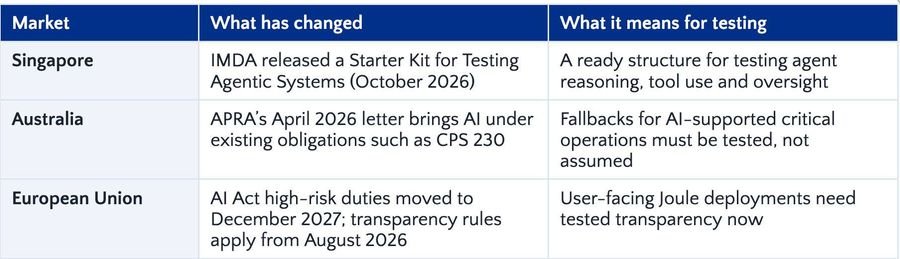
The Digital Omnibus didn’t delay everything, so a good first read is what EU AI Act Article 50 means for SAP Joule.
How Icon Consulting Group applies AI to SAP testing
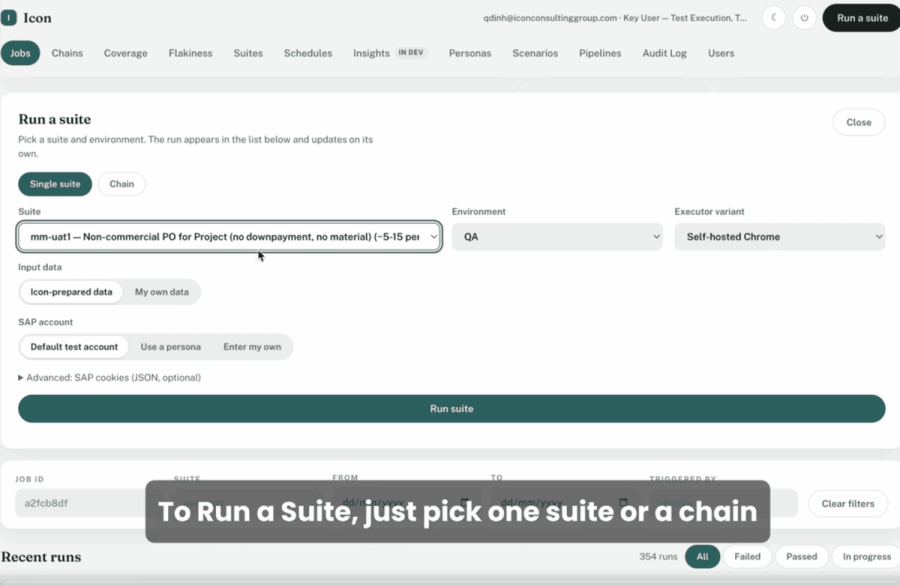
We don’t just advise on SAP AI testing, we run it. Icon’s SAP test platform lets project teams run automated SAP tests on demand, without writing scripts or waiting for a specialist to free up.
What the platform does
- Plain-English scenario search: describe a business case, such as a purchase order with a mandatory down payment, and the platform finds the matching test in the catalogue.
- Runs and chains in a few clicks: pick one suite or chain several, choose QA or UAT, use Icon-prepared data or your own, and connect your SAP account.
- Exact failure evidence: each failed record shows what was expected, what SAP returned, and an exportable results file.
- Flakiness detection: tests that pass and fail on the same input are scored and flagged, so real defects stand out.
- Schedules, pipelines and controls: runs on a timer or on every release through CI/CD, with reusable personas, role-based access and an audit log.
You can watch Icon's SAP AI Testing Platform here.
What changes after adopting it
- Faster cycles: key users trigger regression themselves instead of queuing for the automation team.
- Quicker root cause: failures point to the exact step, field and value, not just a red status.
- More trust in results: separating flaky tests from real failures cuts time wasted on false alarms.
- Audit-ready by default: evidence files and an audit log give you the trail regulators now expect.
Where should you start with SAP AI testing?
Start with change impact analysis, not test generation. It pays off in your very next release, while generated tests only deliver value once a review process exists. That’s the most common sequencing mistake we see in SAP AI testing programmes.
A sequence that works well:
- Baseline your current state: test volume, cycle time and maintenance effort.
- Introduce impact analysis on one release and measure the scope it removes.
- Pilot AI test generation and self-healing on one end-to-end process with a named business reviewer.
- Build agent testing and test evidence in early, before any Joule agent goes live.
Making SAP AI testing work for your team
SAP AI testing isn’t a single tool you switch on. It’s two disciplines: using AI to make testing faster, and testing the AI that SAP and your own teams deploy. Teams that take both seriously will handle quarterly releases and the 2027 deadline with far less risk.
If you’d like a second opinion on where AI fits in your testing approach, talk to Icon’s SAP Consulting team.
Frequently Asked Questions
Can AI replace manual SAP testers?
No. AI can draft tests, repair scripts and narrow the regression scope, but someone who understands the business process still has to define what “correct” looks like and review the results. The tester’s role shifts from writing and running scripts toward designing scenarios and validating outcomes.
What is the difference between SAP test automation and SAP AI testing?
SAP test automation runs predefined scripts automatically. SAP AI testing adds intelligence on top: generating tests, repairing them when screens change and choosing which ones to run. It also covers testing AI features such as Joule agents, which traditional automation wasn’t designed for.
Does the EU AI Act apply to SAP Joule?
SAP has stated that Joule Agents meet the EU AI Act’s definition of an AI system. Transparency obligations apply from August 2026, while high-risk obligations, which can cover uses such as AI in recruiting, now apply from December 2027. Exact obligations depend on the use case, so each deployment needs its own review.
Which SAP testing tools use AI?
SAP’s own testing offerings include SAP Enterprise Continuous Testing and SAP Change Impact Analysis, both built by Tricentis. Independent platforms such as Panaya, Opkey, Worksoft and UiPath also offer AI features like self-healing and impact analysis. The right fit depends on your landscape, release model and existing tooling.
Is SAP AI testing worth starting before the 2027 ECC deadline?
For most organisations, yes. Migration programmes involve heavy regression testing, and impact analysis plus self-healing can shorten those cycles noticeably. Starting during the migration also means your testing approach is ready for S/4HANA’s quarterly release rhythm afterwards.