SAP ECC end of life meets its 2027 deadline fast. See what CIOs need for the S/4HANA migration decision — cost, timeline, and the board case.
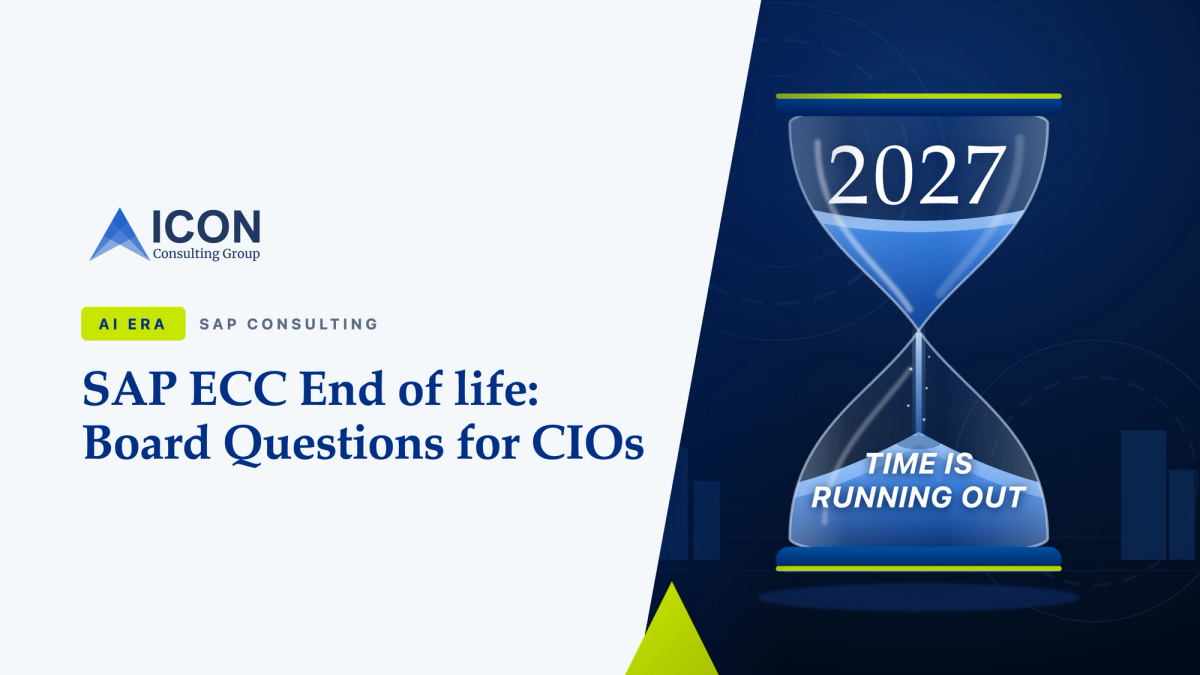
By the time this reaches your board deck, the SAP ECC end of life and S/4HANA migration timeline for 2026 will already be shaping budget conversations whether IT raises it or not. SAP has confirmed there's no further extension past December 31, 2027, and the honest math on migration duration means 2026 is effectively the last year to start with any real control over cost or partner availability. Directors don't want a status update on SAP ECC; they want a clear answer on cost, risk, and sequencing. Here's that answer, in the language a board actually uses.
What Does SAP ECC End of Life Actually Mean?
SAP ECC end of life means mainstream maintenance for SAP's legacy ERP stops on December 31, 2027, after which SAP no longer issues security patches, tax and legal updates, or routine bug fixes without a paid extension. Extended maintenance is available through 2030, but at a premium on top of the standard maintenance fee. Compatibility Packs, the bridge that let some ECC functionality keep running inside S/4HANA, already expired for most customers on May 31, 2026.
Some customers hit this earlier than others. Organizations on ECC 6.0 EHP0 through EHP5 already lost mainstream maintenance on December 31, 2025. EHP6 through EHP8 and Business Suite 7 carry the 2027 date. SAP has paired the deadline with a public commitment to maintain S/4HANA through 2040, as clear a signal as SAP gives about where future investment is going.
Why 2026 Is the Real Deadline, Not 2027
Migrations run 12 to 36 months depending on the path chosen, and partner capacity is already tightening. SAPinsider's 2026 benchmark found 35% of organizations intend to complete their switch to S/4HANA before the end of this year, all drawing on the same limited pool of experienced implementation consultants. Waiting for clarity that isn't coming just moves you further back in that queue.
There's also a schedule-risk number boards rarely see: a Horvath survey found that almost 60% of companies that completed an S/4HANA transformation exceeded their planned schedule. In Icon's engagements, that slippage rarely comes from the technical cutover, it comes from underscoped data cleansing and custom-code remediation discovered too late to protect the go-live date. The fix is starting the landscape assessment now, before a path is even chosen.
Greenfield, Brownfield, or Bluefield: Which Path Fits Your Board's Risk Appetite?
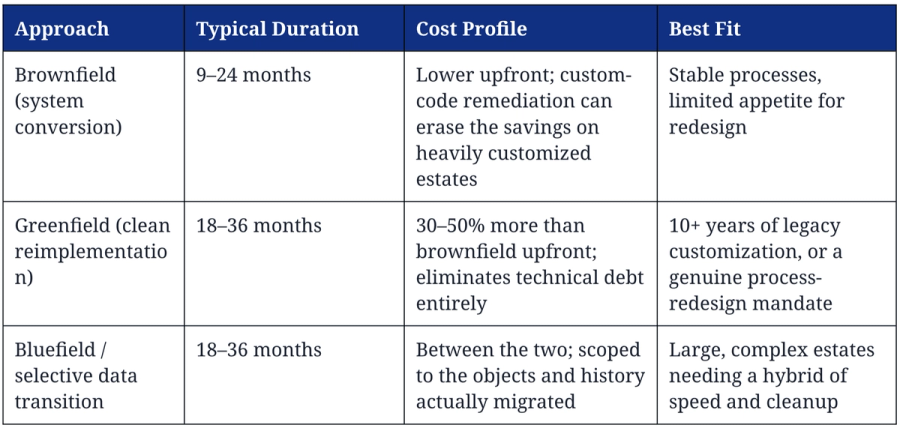
The path decision drives everything downstream, duration, remediation cost, and how much of your existing ECC customization survives the move.
How Long Does an SAP S/4HANA Migration Take?
A brownfield conversion typically runs 9 to 24 months; greenfield reimplementations run 18 to 36 months; bluefield programs land somewhere in between. Organizational complexity, custom code volume, and cloud-versus-on-premise choice move these numbers more than the SAP Activate methodology itself does.
How Much Does an SAP S/4HANA Migration Cost?
Costs scale steeply with scope: Fortune-tier programs covering a full global template frequently exceed $100 million and, in complex multi-entity cases, have run past $400 million over three years. A finance-only (FI/CO) scope for a single-country mid-market implementation lands far lower, typically low-to-mid single-digit millions, which is why scoping the business case around the actual footprint being migrated, not a generic ERP-replacement number, matters more than any vendor benchmark.
Why the Business Case Still Doesn't Add Up for Half of ECC Customers
Gartner projects roughly 17,000 customers, close to half the ECC install base, will still be running the system when the 2027 deadline arrives; IDC puts the remaining share at 40 to 45%. The barrier isn't awareness: in one 2025 industry survey, 95% of respondents said building a positive ROI case for S/4HANA is difficult, and nearly nine in ten worried about unpredictable ongoing subscription costs.
Here's the practitioner take Icon gives clients stuck at this stage: most boards are pitched the wrong ROI framing. The pitch usually leads with innovation upside — AI, real-time analytics, better UX — a payback-period argument that's genuinely hard to win against a multi-year, eight-figure price tag. What actually lands is risk-adjusted cost of delay: stacked extended-maintenance premiums, audit exposure from running unsupported systems, and the near-certainty of a compressed, costlier migration if the decision waits until 2028. That's a number CFOs already know how to evaluate.
--> Read more: What AI Is Changing on SAP Programmes (And What It Isn't)
What Your Board Actually Needs to Hear From You
Skip the Fiori screenshots. A board wants five specific things in the SAP ECC end of life conversation:
The hard deadline and the do-nothing cost — what extended maintenance actually costs per year through 2030, and what happens after that.
The chosen migration path and why, with a cost range tied to your actual scope, not an industry average.
A realistic timeline that starts now, including the assessment work that has to happen before a path is even finalized — see how custom code volume typically drives remediation cost estimates.
Clear governance — who owns the program, and how often the board will see progress against budget and schedule.
The cost of waiting another year — partner scarcity, pricing pressure, and shrinking runway all get worse, not better.
How to Build the Roadmap: Who Should Own the Migration?
The CIO owns the program, but ownership can't stop at IT — a named business sponsor with budget authority needs to co-own the business case and the change management plan, or the program stalls the moment it touches finance and operations processes outside IT's control.
A workable 2026 sequence:
- Landscape and custom-code assessment — inventory customizations, add-ons, and data quality issues before choosing a path.
- Path decision — greenfield, brownfield, or bluefield, scored against the assessment findings, not a vendor recommendation.
- Partner selection — evaluate on completed go-lives, not implementations merely started, and on relevant industry localization experience.
- Commercial negotiation — if moving to RISE with SAP, start contracting in parallel with partner selection; see our RISE with SAP negotiation guide for what typically slows this step down.
- Program governance — a standing board reporting cadence from kickoff, not just at milestones.
The SAP ECC end of life deadline isn't moving, and the S/4HANA migration math only gets less favorable the longer organizations wait. Treat 2026 as the last full planning year, get the assessment done regardless of which path you eventually choose, and bring your board a decision framed around cost of delay rather than a features pitch. Talk to Icon's Advisory & Transformation team to build the business case and roadmap your board will actually approve.
Frequently Asked Questions
1.What is RISE with SAP, and does it matter for ECC end of life?
RISE with SAP is SAP's bundled offering that combines S/4HANA Cloud, infrastructure, and managed services under a single subscription contract. It matters for ECC end-of-life planning because choosing RISE changes your commercial negotiation timeline and can shift parts of the technical migration workload onto SAP and its hosting partners.
2. What happens if we don't migrate before the SAP ECC deadline?
After December 31, 2027, organizations without extended maintenance lose SAP-delivered security patches, tax and legal updates, and bug fixes for ECC. Extended maintenance is available through 2030 at a premium, but it doesn't stop the underlying cost and risk clock — it only delays the eventual migration.
3. Can SAP ECC support be extended beyond 2030?
SAP has stated the 2027 mainstream maintenance date is final, with extended maintenance capped at 2030 and a small set of modules, including Transportation Management and Customer Service, already running to 2030 by default. No further blanket extension has been announced.
4. Is SAP S/4HANA available on-premise, or only in the cloud?
Both. S/4HANA is available as an on-premise deployment, a private cloud edition, and a public cloud edition (including via RISE with SAP), and the deployment choice is a separate decision from the greenfield, brownfield, or bluefield migration path.
5. What's the actual difference between SAP ECC and S/4HANA?
SAP ECC runs on a traditional relational database, while S/4HANA runs on SAP's in-memory HANA database, enabling faster processing and real-time analytics. S/4HANA also introduces a simplified data model, a redesigned Fiori user experience, and is the platform where SAP is directing all future AI and automation investment.