AI is reshaping SAP delivery, from clean core to testing and master data. See what's really changing on SAP programmes, and what isn't.
“AI on SAP” is in every vendor deck right now, but few mid-market IT leaders have watched an AI-driven SAP programme run at scale, as opposed to a demo in a sandbox. That gap matters more than it did a year ago, because SAP ECC mainstream support winds down at the end of 2027, and the calculus around that decision has shifted with the technology. Here's what AI is genuinely changing in SAP implementation work — the platform, the programme, and the operating model — and what it hasn't touched at all.
Why an AI-Driven SAP Programme Is Suddenly on Every Roadmap
Three things changed at once, and none is an argument for buying software faster.
The clock. ECC support ends, and every mid-market SAP estate now has a dated decision in front of it. No version is cheap.
The template. Mid-market organisations have historically borrowed enterprise programme templates — governance layers, rate cards, staffing models — and inherited enterprise cost and duration with them, even though their landscapes are a fraction of the size.
The method. For the first time, the delivery work itself can run differently, not just get sold differently with an “AI-powered” label on the same statement of work.
That third point is the one most vendors gloss over.
What AI Is Actually Changing on SAP Programmes
An AI-driven SAP programme changes in three places, each with different implications for your roadmap.
In the Platform: Clean Core Stops Being Optional
SAP is embedding AI into the product itself, not bolting it on as a side panel. The core is becoming something you configure less and govern more. Every AI capability SAP ships assumes a clean core — standard, auditable, unmodified. Modification debt used to be a maintenance cost; now it's a capability tax, since every workaround you kept is a feature you can't switch on.
In the Programme: Design, Configuration, Testing and Data Compress First
Design, configuration, testing and data migration are the volume activities on any SAP programme, and they compress hardest under AI-augmented delivery. Configuration is built and iterated at a pace no team matches by hand, then reviewed by seniors rather than built by them line by line. Test scripts are generated, executed and evidenced end to end instead of written manually. Master data is extracted, mapped and loaded through a dedicated tool-chain instead of a spreadsheet and a prayer.
In the Operating Model: The Bottleneck Moves From Capacity to Judgement
This is the change with the most consequence for staffing. When volume work compresses, the constraint stops being “how many consultants can we put on this” and becomes “how much senior judgement do we have to review what the AI produced.” Fewer people are needed, but more senior ones, and accountability concentrates rather than spreads.
How Much Time and Cost Does AI Actually Save on an SAP Implementation?
Industry research puts the figure at 15–20% off total programme cost when generative AI is applied correctly across a RISE with SAP transformation, according to Capgemini. Our own numbers from a live global rollout back that up: of roughly 120 entities in a single-instance S/4HANA Public Cloud programme, 70 went live using conventional delivery, while the current wave of 28 is running entirely AI-driven — same client, same team, same programme, so the comparison is real.
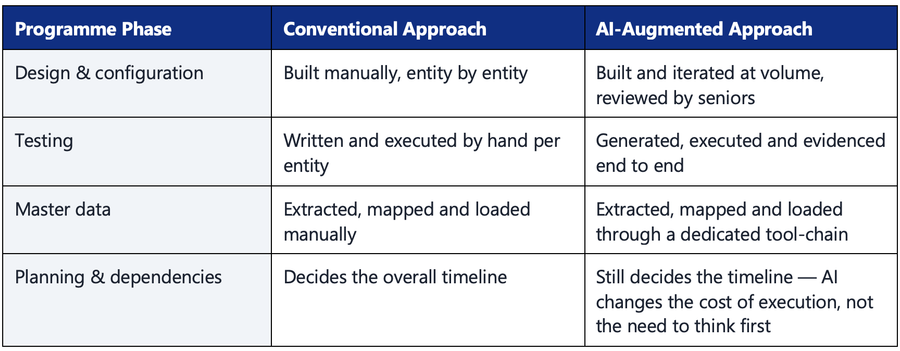
AI does not remove the hard part of an SAP programme. Planning still decides the timeline, and managing dependencies decides it even more.
How Icon's AI-Augmented SAP Model Actually Works
Two proof points sit behind everything above, worth naming specifically because “we use AI” is a claim any vendor can make.
The agents are ours. Icon's engineers have built and productised three agents that carry the volume work on an SAP programme: SAP Configuration (built and iterated at volume, reviewed by seniors), SAP Testing (generated, executed and evidenced end to end), and SAP Master Data (extracted, mapped and loaded through a dedicated tool-chain). A secondary set runs in live operations after go-live, covering accounts payable, reconciliation and exceptions. These are productised tools, not something rebuilt from scratch per engagement — “we partner with an AI vendor” is a sentence anyone can write; a named, demonstrable toolset is harder to fake.
One trusted core, a surround composed per client. SAP S/4HANA stays standard and auditable — the system of record, not the differentiator — connected through a governed posting interface with a human kept in the loop. Around that core sits a surround built per client: fit-for-purpose apps built for one process rather than forty, agents for AP, reconciliation, exceptions and master data, best-of-breed tools chosen per client rather than per deal, and existing systems kept wherever they already earn their place. Every SAP vendor will have agents soon. Auditable agentic execution — a clear owner, a validated output, and a human still signing off before anything posts — is what separates one AI-driven SAP programme from another.
Three Decisions an AI-Driven SAP Programme Puts in Front of Your Roadmap
Clean core has gone from best practice to entry condition. If it was a recommendation before, it's a prerequisite now — every custom object you're carrying is standard AI functionality you can't switch on.
What questions should you ask an AI-augmented SAP partner? Method matters more than headcount: what actually runs augmented versus what's manual with an AI label on it; who validates the AI's output before it reaches your system; and where the audit trail lives.
The timing calculus has changed. A decision deferred to 2028 used to carry a predictable cost: a later start, a tighter runway to the ECC deadline. That's different now, because the work organisations typically deferred — design, configuration and testing — is exactly the work that just compressed.
How Do You Test an AI-Augmented SAP Partner Before You Sign Anything?
You test it against your own ERP data, not a reference call, typically over two weeks and at no cost.
Day 0: Your own ERP data, mapped process by process rather than through a generic questionnaire.
Week 1–2: The assessment runs senior-led at the front, AI-augmented behind the scenes, against what your systems actually do.
Day 14: A costed, sequenced roadmap — a board-ready decision rather than a slide deck of opinions.
The proof is the product, before you've spent anything. Anyone can write “we partner with an AI vendor” in a proposal; a fixed-scope two-week pulse assessment is harder to fake. This isn't theoretical, either — the buying and living-with-it experience is exactly what Icon's customer panels cover, with IT leaders like Christophe Le Mao, Global VP of IT at Aleph Group, speaking directly to what evaluating and running an AI-augmented SAP partner is actually like once the contract is signed.
What Mid-Market SAP Buyers Are Actually Asking For Now
Feedback from buyers in markets like Australia is unusually consistent, and it's a useful gut-check for any mid-market IT leader evaluating an AI-driven SAP programme right now:
Prove it on my own data, not a reference call. Buyers want evidence against their own systems, not someone else's case study.
Fixed scope, senior people, no year-long blueprint first. They want the people they meet in week one still in the room in month three, with no twelve-month discovery phase in front of it.
A structural gap, not a price gap. The mismatch mid-market buyers describe isn't that enterprise-grade delivery costs too much — it's that programme structures, governance layers and rate cards were sized for organisations ten times their size. AI-augmented delivery is what makes a right-sized alternative possible without cutting corners on rigour.
The Bottom Line
None of what's changing here is a reason to buy software faster. AI is the vehicle; senior judgement is still the driver. What's genuinely different is what a well-run AI-driven SAP programme now costs, how fast the volume work moves, and where your accountability needs to sit. If your ECC estate is heading toward that 2027 deadline, the question worth asking isn't whether to move — it's whether your next partner can prove, on your own data, what an AI-augmented approach actually looks like before you sign anything. Talk to Icon's SAP Consulting team to scope a two-week pulse assessment against your own SAP estate.
Frequently Asked Questions
1.When does SAP ECC mainstream support end?
Mainstream maintenance for SAP ECC 6.0 (Enhancement Packages 6–8) ends on 31 December 2027. Extended maintenance is available through 2030 at a cost premium, and a private-edition transition option can stretch support further for eligible RISE with SAP customers, but no path is free.
2. What is SAP clean core, and why does it matter for AI?
Clean core means running SAP S/4HANA as close to standard as possible, with customisations kept out of the core and pushed to extensions instead. It matters for AI because nearly every AI capability SAP ships assumes that standard, auditable foundation — heavy modification debt blocks access to it.
3. Is AI replacing SAP consultants?
No. AI compresses the volume work — configuration, testing, master data — but planning, dependency management and sign-off still require senior, accountable people. What changes is the ratio: fewer consultants doing manual build work, more senior people reviewing and validating what the AI produced.
4. Do I need RISE with SAP to use SAP's AI features?
Not exclusively. SAP's AI investment spans S/4HANA public cloud, private cloud and RISE with SAP contracts, but the real precondition is clean, structured data and simplified processes rather than any one specific commercial packaging.
5. Can mid-market companies access the same AI agents as large enterprises?
Yes, but the deciding factor is the partner's method, not their headcount. Productised, purpose-built agents for SAP configuration, testing and master data can be deployed by a focused mid-market partner just as effectively as by a large systems integrator — sometimes more effectively, because they aren't rebuilt from scratch on every engagement.
6. What does “auditable agentic execution” mean, and why does it matter?
It means every AI agent's output is checked by a person before it posts into your system of record, with a traceable record of who approved what and when. As agents become standard across every SAP vendor, this governance layer — not the agents themselves — is what actually separates one AI-driven SAP programme from another.