AI-augmented SAP testing speeds up test design, scoping and maintenance. See what changes for quality and QA teams, and where to start.
AI-augmented SAP testing uses AI to carry the heavy lifting in the test lifecycle: drafting test cases from process models and specs, working out which tests a change actually affects, generating test data, and repairing automated scripts when screens change. People still decide what "correct" looks like. With SAP ECC end of life approaching and quarterly cloud releases now the norm, that's a genuine shift, so here's what changes for quality, speed and QA teams, and where the hype runs ahead of reality.
What is AI-augmented SAP testing?
It's an approach where AI assists testers across design, scoping, execution and analysis, rather than only replaying scripted clicks. AI proposes; humans approve.
Classic test automation as a robot that replays the steps you recorded. AI augmentation is closer to a sharp junior analyst who reads the change, suggests what to test and drafts the scripts for you to review.
It's already in mainstream tooling. SAP's Joule assistants can define a risk-based test scope, generate test cases in SAP Cloud ALM and create test data, and Tricentis offers AI-assisted test generation inside SAP Enterprise Continuous Testing.
How is AI used in SAP testing?
AI-augmented SAP testing shows up in five places. Most teams start with one or two.
- Test case generation. Drafting tests from specs, user stories, SAP Signavio process models or recorded sessions.
- Change impact analysis. Reading transports and configuration changes to see which processes are touched, so regression scope is risk-based.
- Self-healing automation. Updating locators automatically when a Fiori screen or field ID changes.
- Test data generation. Building realistic variants, such as pricing conditions or company-code splits, that are tedious by hand.
- Defect triage. Clustering failures with the same root cause and summarising logs into readable release-readiness notes.
Where does AI fit across the SAP ERP implementation stages?
The stages themselves don't change; the timing of test work does. In an AI-augmented SAP ERP implementation, test design moves earlier, from Realize into Explore, because test cases can be drafted as soon as processes are agreed.
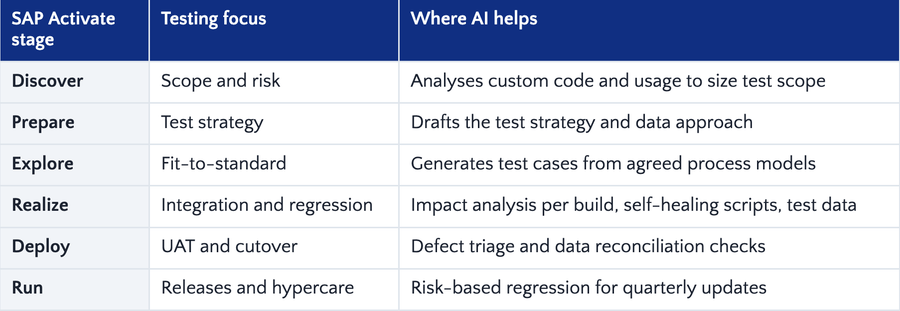
How AI-augmented SAP testing changes quality and speed
Where the speed actually comes from
Execution was already fast with conventional automation. The real savings come from the slow, human-heavy parts: designing tests, scoping regression and maintaining scripts after every release.
Vendor estimates put testing at 30–45% of a global SAP deployment budget, and AI testing providers advertise effort reductions of up to 70%. Treat that 70% as a ceiling seen in well-prepared programmes, not a planning baseline.
Why does SAP ECC end of life make this more urgent?
Mainstream maintenance for SAP ECC 6.0 ends on 31 December 2027, with optional extended maintenance to the end of 2030 at a premium. Many ECC customers still haven't migrated, so test teams and partner capacity will be stretched late in the decade. AI-augmented SAP testing is one of the few levers that raises test throughput without adding headcount at the same rate.
→ Read more: ECC End-of-Life Is the Board Question
Does AI improve SAP test quality, or just test volume?
Only if you control it. AI makes tests cheap to create, so without governance teams get bigger suites, not better coverage, and every extra test needs maintaining.
Quality improves when AI is used to find gaps and cut redundant tests, and when every generated test passes a human review gate. An AI that invents a test step or classifies the same defect two ways is a liability.
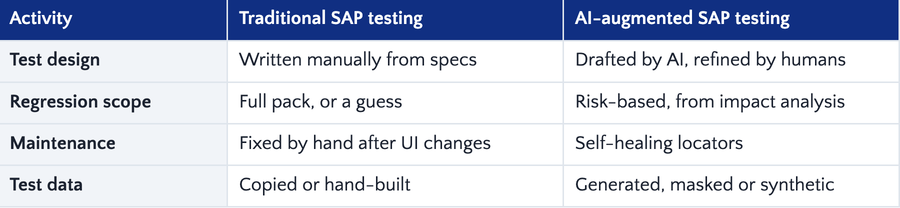
Will AI replace SAP testers?
No, but AI-augmented SAP testing changes the job. AI takes over repetitive design, maintenance and analysis, while testers move toward quality engineering: deciding what to test, validating AI output and owning risk.
Accountability doesn't move. The QA lead still signs off release readiness, and process owners still confirm that order-to-cash or procure-to-pay behaves as the business needs. The skills that grow in value:
- Critically reviewing AI-generated tests for missing negative cases and unrealistic data.
- End-to-end testing across S/4HANA, SAP BTP extensions and third-party systems, where AI tools are weakest.
- Writing clear acceptance criteria, because AI output is only as good as the test basis.
Our take: start with impact analysis, not test generation
The most common mistake we see in AI-augmented SAP testing is a first pilot that amounts to "generate 500 test cases from our specs". The specs are out of date, the tests inherit those errors, and the team maintains more than before. We'd sequence it differently.
The sequencing we recommend
1. Fix the test basis first
Update process documentation. A clean core landscape also gives AI far less ambiguity to work through.
2. Switch on change impact analysis
Measure how much regression scope it removes on your next release. That number is your business case.
3. Add self-healing to your regression pack
Fiori-heavy suites see the quickest maintenance relief.
4. Then introduce generative test design, with a review gate
Apply it to new scope first, such as an S/4HANA migration wave, with human approval and an audit trail. Start before a major test cycle, not mid-UAT.
Conclusion
AI-augmented SAP testing doesn't remove the need for good QA; it removes the drudgery that kept good QA people from their best work. Expect the biggest gains in test design, scoping and maintenance, govern generated tests tightly, and redeploy testers toward risk and end-to-end coverage. As an augmented SAP boutique, Icon helps teams do this without losing control of quality.
Talk to Icon's SAP Consulting team about an AI-augmented testing approach for your next release or ECC migration.
Frequently Asked Questions
When does SAP ECC reach end of life?
SAP ends mainstream maintenance for ECC 6.0 (enhancement packages 6–8) on 31 December 2027. Optional extended maintenance runs to 31 December 2030 at a two-point premium on the maintenance rate. Eligible RISE with SAP customers can use the SAP ERP private edition transition option, which extends coverage to 2033.
What happens if we stay on SAP ECC after 2027?
ECC keeps running; the support model changes. Without extended maintenance you move to customer-specific maintenance, which excludes new legal changes and support packages, and after 2030 that limited coverage applies to everyone not on another path. Third-party support is an option, but it doesn't give access to S/4HANA innovation.
Which tools support AI-driven SAP testing?
SAP offers AI test assistance through Joule and SAP Cloud ALM, and SAP Enterprise Continuous Testing by Tricentis includes AI-assisted test case generation. Worksoft, UiPath Test Cloud, Qyrus and SmartBear Reflect also have SAP-specific AI features. The right fit depends on your mix of SAP GUI, Fiori and non-SAP systems.
What is self-healing test automation in SAP?
Self-healing automation detects when a UI element such as a Fiori field has changed its ID or position and updates the test's locator automatically. It cuts the maintenance work that follows each SAP release. Tests where business logic has changed still need a person.
Is AI-generated test data safe to use in SAP projects?
It can be, provided the data is synthetic or properly masked and never exposes real personal or financial records. Check where the AI tool processes data and whether that meets GDPR or local data-protection rules. Version generated data sets so results stay reproducible.
Can AI help with S/4HANA migration testing?
Yes. AI can propose a risk-based scope, generate test cases for migrated processes and produce data for reconciliation checks. SAP positions its Joule test management assistant specifically for ECC-to-S/4HANA moves. Financial reconciliation still needs human sign-off.